
Rotaria builds your quaternary treatment with pipe reactor ozonation
Ozone in a pipe.Not in a concrete tank.Rotaria quaternary treatment: modular ozonation in a pipe reactor
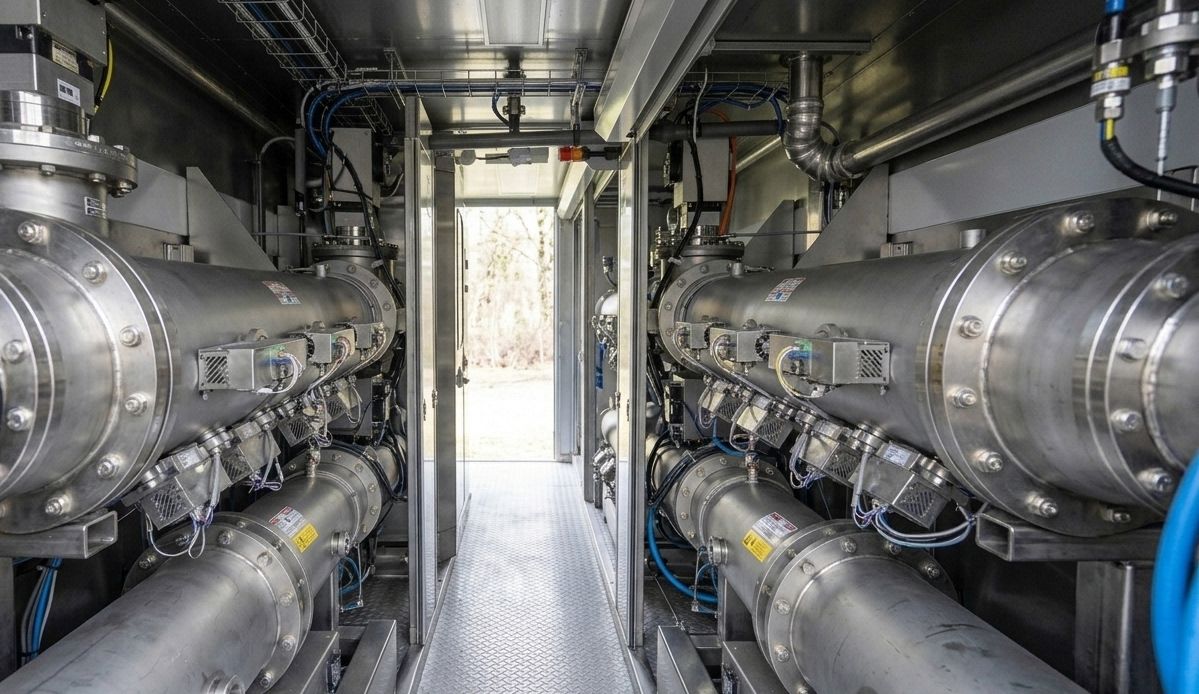
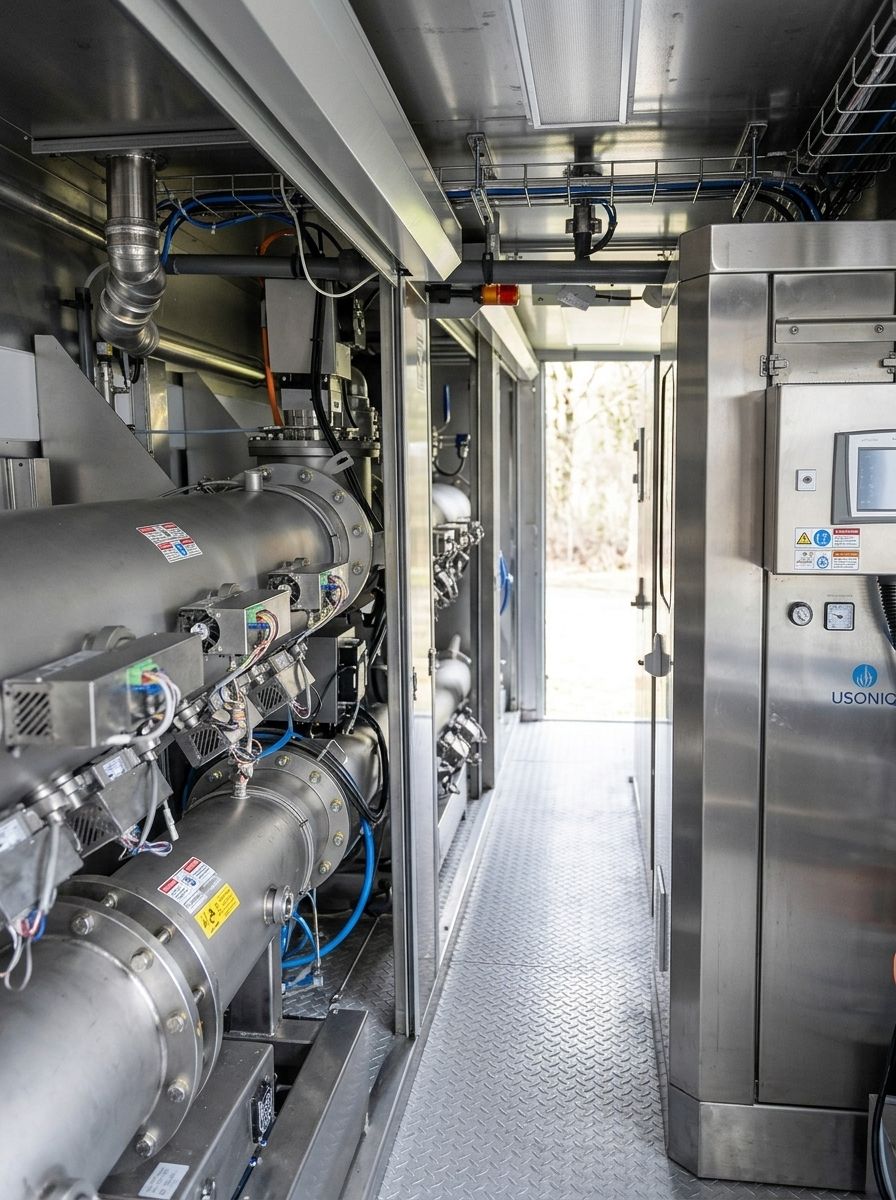
Ozonation in a stainless steel pipe: delivered pre-assembled, extended module by module, switched by flow.
- 30 sinstead of 20 min retention time
- 100,000 PEmaximum plant size, modular from 5,000 PE
- 1 to 10DN 300 trains, switched in by flow
- 0concrete tanks for the reactor
30 seconds instead of 20 minutes.
Concrete ozone reactors are usually built with two lanes at most and sized for full hydraulic load at around 20 minutes of retention time. Yet many plants run at full load for only about 5% of the year. The pipe reactor works in seconds, needs far less hydraulic volume and switches train by train to match the actual flow.
| Concrete reactor | Pipe reactor | |
|---|---|---|
| Retention time | approx. 20 minutes | approx. 30 seconds |
| Hydraulic volume | large, built for full load | far smaller: no reaction tank |
| Lanes | usually 2 at most | 1 to 10 trains |
| Part load | full volume always in place | staged: only the trains needed are running |
| Extension | new tank | one more train or container |
Pipe reactor retention time: approx. 30 s by design, under 1 minute in the published study. Concrete reactors: 15 to 30 minutes recommended (KOM-M.NRW).
Technology that blends in.
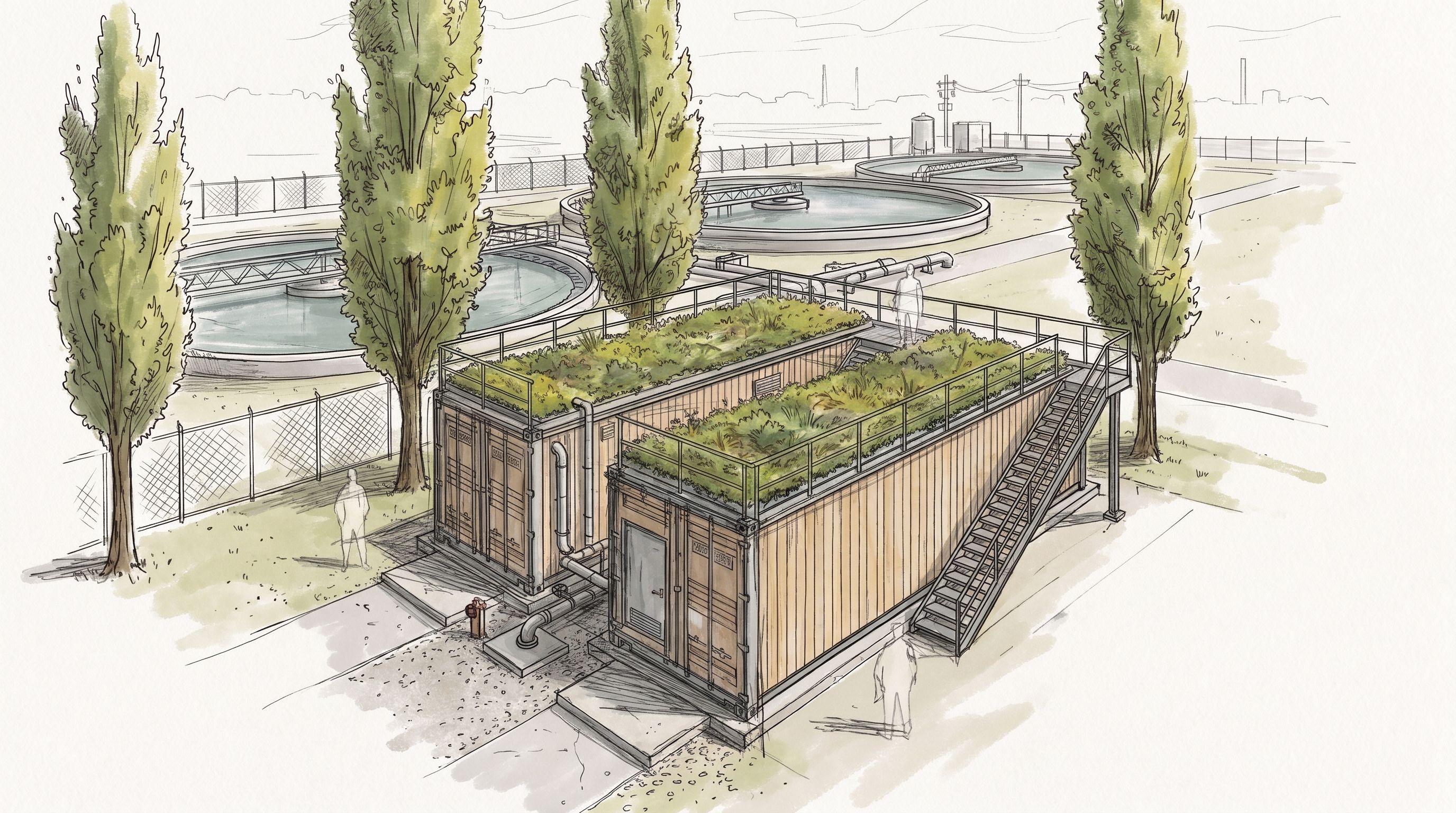
A few containers on site replace huge concrete tanks. That means less concrete, less earthwork and less disturbance of soil and groundwater. With a green roof and timber cladding, quaternary treatment becomes a structure that suits its surroundings.
Quaternary treatment is coming. Your site is not getting any bigger.
The recast EU Urban Wastewater Treatment Directive phases in micropollutant removal by 2045 for plants from 150,000 PE, and from 10,000 PE in areas at risk. Pipe reactor ozonation fits where space or ground conditions rule out a new concrete tank. Directive (EU) 2024/3019, Art. 8
Six reasons to go with the pipe
Almost no civil works
No concrete tank, no groundwater lowering, no building. The reactor sits in the container.
Small footprint, fast to install
The equipment arrives pre-assembled. The concept for 25,000 PE needs approx. 44 m², excluding access ways and LOX tank.
Follows the flow
Staged operation: only the trains the current flow requires are running. At low flow the others stay off.
Redundancy built in
If one train fails, the others take over as long as spare trains are available.
Grows with you
Add trains or containers later, even on tight sites.
Hardly any time for bromate
Bromate needs long ozone exposure, the pipe reactor works in seconds. In the study, formation stayed practically absent even with bromide up to 1,000 µg/L.
How it works
Switch in
One or more trains run, depending on flow.
Inject ozone
The dynamic mixing unit injects ozone into the wastewater stream.
React
Approx. 10 m reaction length in a DN 300 stainless steel pipe, assisted by ultrasound.
Complete the reaction
The ozone is consumed along the pipe. At the end, no appreciable residual ozone remains in the water.
Technical data
| Plant size | 5,000 to 100,000 PE, modular |
|---|---|
| Hydraulic capacity | up to 707 l/s |
| Trains | 1 to 10, switched in by flow |
| Material | stainless steel 1.4404 (316L) |
| Retention time | approx. 30 seconds |
| Removal | 80% at 0.24 mg O₃/mg DOC |
| Treatment cost | €0.09/m³, of which €0.03/m³ operating (pilot study, 2017 cost basis) |
Measured in reference operation.
80% removal at just 0.24 mg O₃/mg DOC.
Mean of six indicator substances across the treatment plant with pipe reactor ozonation. Journal of Environmental Chemical Engineering 13 (2025) 117440
Where pipe reactor ozonation fits and what to check first
A good fit for
- Municipal plants from 5,000 to 100,000 PE, including retrofits
- Tight sites, difficult ground, high groundwater
- Strongly varying flows thanks to staged operation
- No relevant bromate formation, even with bromide up to 1,000 µg/L
To be clarified first
- Biological post-treatment not included, recirculation via the final clarifier possible
- More wear parts than a concrete reactor: piezo elements and mixing unit bearings
- Bromate depends on the wastewater: mobile test unit for your site
- 1 m/s design point is calculated, measurements were at lower flow
Datasheet and tender specification
Quaternary treatment by pipe reactor ozonation: common questions
What does the new Urban Wastewater Treatment Directive require?
Directive (EU) 2024/3019 requires quaternary treatment by 2045 for all plants of 150,000 PE and above, and for plants from 10,000 PE in areas where micropollutants pose a risk to water bodies or drinking water. Plants must remove at least 80 % of micropollutants, measured on defined indicator substances. The obligation is phased in: 20 % of the affected plants by 2033, 60 % by 2039. Producers of pharmaceuticals and cosmetics are to cover at least 80 % of the costs through extended producer responsibility. Rotaria pipe reactor ozonation is modular from 5,000 to 100,000 PE, which makes it a good fit for plants in risk areas.
What plant sizes is pipe reactor ozonation suitable for?
Modular from 5,000 to 100,000 PE. The number of trains and containers depends on your flow. Trains or containers can be added later.
What is the retention time in the reactor?
Seconds rather than minutes: approx. 30 seconds by design, under one minute in the published study. For concrete reactors 15 to 30 minutes are recommended.
How does pipe reactor ozonation differ from conventional ozonation?
The reaction takes place in a DN 300 stainless steel pipe instead of a concrete contact tank. A dynamic mixing unit injects the ozone and ultrasound assists. The equipment arrives pre-assembled in modular containers and is switched in by flow.
How much space does a pipe reactor ozonation plant need?
The concept for 25,000 PE uses 3 containers with a footprint of approx. 44 m², excluding access ways and LOX tank.
What removal performance has been demonstrated?
Pilot and reference operation achieved a mean removal of 80% for six indicator substances at just 0.24 mg O₃/mg DOC, across the treatment plant and ozonation combined. The study is published in a peer-reviewed journal. Results at your plant depend on your wastewater.
What flow can one train handle?
Measured in reference operation: 12.5 to 46.9 m³/h with no significant change in removal. The calculated design point is 255 m³/h, equal to 1 m/s in a DN 300 pipe.
Does pipe reactor ozonation need biological post-treatment?
That depends on the site and the regulator. Post-treatment is not part of the scope. With Rotaria, recirculation via the final clarifier is possible.
What about bromate formation?
Bromate needs long ozone exposure, the pipe reactor works in seconds. In the peer-reviewed study, bromate stayed practically absent even with bromide up to 1,000 µg/L and high ozone doses: detectable in 2 of 22 samples, both within the drinking water limit. A mobile test unit can check your wastewater in advance.
What happens if a train fails?
The other trains take over as long as spare trains are available. We define the size of that reserve with you.
What maintenance is required?
According to the operating report: piezo elements every 5 years, mixing unit bearings every 2 years and approx. 100 staff hours per year.
Is pipe reactor ozonation always cheaper than a concrete reactor?
No, it depends on the project. In the pilot study, treatment costs were €0.09/m³ (2017 cost basis), below those of conventional ozonation for plants up to 100,000 PE. We are happy to run the numbers for your project.
Does quaternary treatment also remove microplastics?
Not the ozonation. Ozone breaks down dissolved micropollutants such as pharmaceutical residues. Microplastics are solid particles that ozone does not remove. That takes filtration, for example a sand or cloth filter. Conventional treatment already retains a large share of microplastics in primary and secondary clarification.
Images have been optimised for better presentation.
Will pipe reactor ozonation fit your plant?
Send us plant size, flow and available area. We will tell you how many trains and containers you need.
Worldwide delivery. Advice in German and English.