
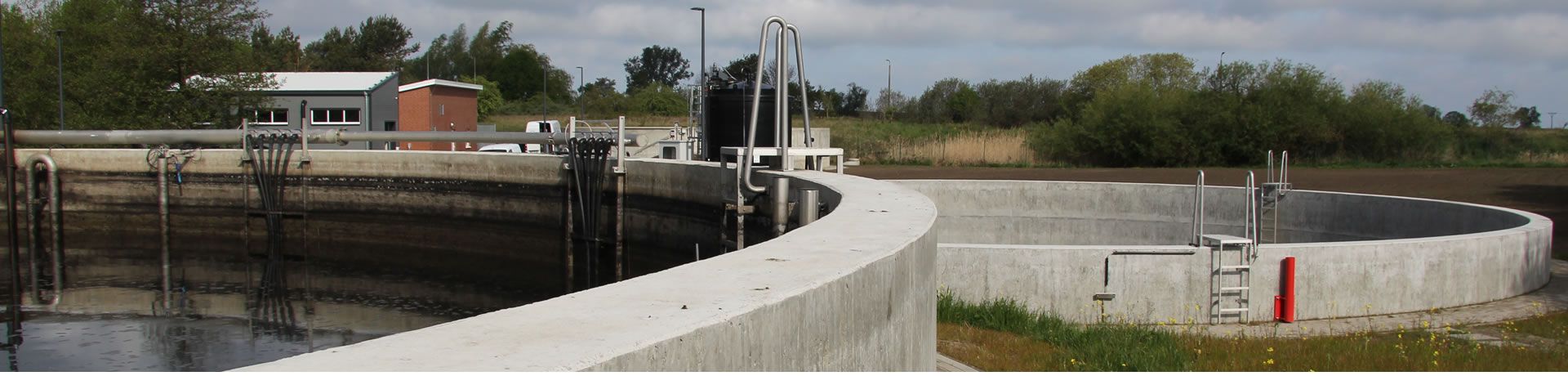
Rotaria upgrades your SBR plant with the TSC process
More capacity.No new tank.TSC process: upgrading SBR plants with two-stage cycling
The buffer tank becomes reaction volume, so your existing tanks and equipment can treat a larger load.
- approx. 30%more capacity from the same tank volume
- +1,000 PESpornitz: from 1,600 to 2,600 PE
- €236/PEnet including design at Spornitz
- 6plants built or converted to TSC
- 50 to 9,950PE built so far
The buffer tank goes to work.
In a conventional SBR the wastewater just waits in the buffer tank, and reactions stop during settling and decanting. In the TSC process the buffer tank becomes reaction volume. Treatment is split across two tanks and carries on while the N tank decants.
| SBR process | TSC process | |
|---|---|---|
| Buffer tank | storage only | storage, denitrification and bio-P |
| Treatment phases | one after another in one tank | split across two tanks |
| Settling and decanting | no reaction time | DN tank keeps reacting |
| Cycle time | set by timer program | adjusts itself to the inflow |
| Aeration | mixing phases cost aeration time | longer aeration time in the N tank |
Approx. 30% more capacity from the same tank volume compared with conventional SBR: figure from Rotaria.
How the TSC process works
Filling the N tank
After decanting, the recirculation pump moves wastewater and activated sludge from the DN tank into the N tank.
Biological treatment
Both tanks recirculate. Nitrate returns to the DN tank and is denitrified there until the top water level is reached.
Decanting
Sludge settles in the N tank and clear water is decanted. Incoming wastewater is held in the DN tank.
Six reasons for TSC
More from what you have
Approx. 30% more capacity from the same tank volume, because the buffer tank works as reaction volume.
Existing equipment stays
Aeration, decanter and waste sludge removal remain in use.
Upgrade during operation
At Spornitz the conversion was done step by step while the plant kept running.
Cycle regulates itself
High inflow shortens the cycle, low inflow lengthens it. That is how the process handles seasonal peaks.
Better denitrification and bio-P
All wastewater enters the DN tank, where plenty of readily biodegradable carbon is available.
Less odour
Activated sludge in the DN tank processes odorous compounds at once instead of leaving them standing in a buffer tank.
What stays and what is added
Stays
- Inflow
- Aeration and mixing in the SBR tank, now the N tank
- Decanter
- Waste sludge removal
Added
- Recirculation line and pipework changes
- Recirculation pump if there is no gravity fall to the N tank
- Updated PLC program and visualisation
- Option: ammonium and nitrate measurement
Is your decanter due for replacement anyway? See the Rotaria KWA
Technical data
| Process | Two-stage cycling (TSC), two-stage fill-and-draw |
|---|---|
| DN tank | buffer storage, denitrification, biological phosphate release |
| N tank | nitrification, carbon removal, settling, decanting and waste sludge removal |
| Control | automatic cycle time via PLC |
| Design | verified to DWA-A 131 for each plant |
| Built so far | 50 to 9,950 PE |
Spornitz wastewater plant
From 1,600 to 2,600 PE at €236/PE.
Net including design, under 2 years from planning to completion. wwt 1-2/2021
Effluent values after the upgrade
| Parameter | Discharge limit | Operation |
|---|---|---|
| COD | 90 mg/l | 43.6 mg/l |
| BOD₅ | 20 mg/l | 4.2 mg/l |
| Total N | 10 mg/l | 3.6 mg/l |
| NH₄-N | 8 mg/l | 2.7 mg/l |
| Total P | 2 mg/l | 0.6 mg/l |
Mean of 16 effluent samples, Spornitz plant. Electricity use before 1.06 kWh/m³, after 0.90 kWh/m³. Source: presentation by WAZV Parchim-Lübz, 1 December 2021.
Reference plants
| Plant | Size | Scope | Year |
|---|---|---|---|
| Nebel (Amrum, Germany) | 9,950 PE | 2nd expansion stage | 2002/2003 |
| Crivitz (Germany) | 6,000 PE | conversion of a two-lane oxidation plant | 2005 |
| Wittdün (Amrum, Germany) | 4,000 PE | TSC plant | 2002/2003 |
| Spornitz (Germany) | 2,600 PE | conversion of an SBR plant | 2019/2020 |
| Reimershagen (Germany) | 400 PE | first TSC plant | 2000 |
| Möderitz (Germany) | 50 PE | conversion of a rotating biological contactor | 2007 |
Where TSC fits and what to clarify first
A good fit for
- Upgrading existing SBR plants
- Converting other plant types such as oxidation or RBC plants
- New fill-and-draw wastewater plants
- Strong seasonal variation, for example in tourist regions
To be clarified first
- Where the DN volume comes from: free space, reuse or new build
- Tank elevations: possibly a second recirculation pump
- Phosphorus: chemical precipitation may still be needed
- Built up to 9,950 PE so far, larger plants assessed individually
Process description and documents
TSC process: common questions
What is the TSC process?
TSC stands for two-stage cycling. It is a two-stage fill-and-draw wastewater treatment process developed from SBR. The biological reaction volume is split into a DN tank and an N tank, with recirculation between them in defined phases.
How does TSC differ from SBR?
In SBR all phases run one after another in one tank. In the TSC process the buffer tank is used as anoxic and anaerobic reaction volume, and the phases are split across two tanks.
How much capacity do I gain?
From the same tank volume, Rotaria expects approx. 30% more capacity than conventional SBR. The Spornitz plant went from 1,600 to 2,600 PE, where the sludge storage tank was also reused.
Do I need a new tank?
Often not. The extra DN volume can come from free space in the buffer tank or from reusing a large sludge storage tank. If that is not enough, a DN tank can be newly built.
Can the plant keep running during the upgrade?
Yes. At Spornitz the conversion was done step by step during operation.
What does a TSC upgrade cost?
That depends on the plant. At Spornitz the expansion by 1,000 PE cost €236/PE net including design.
What effluent values are achieved?
At Spornitz, mean of 16 samples: COD 43.6 mg/l, BOD₅ 4.2 mg/l, total N 3.6 mg/l, NH₄-N 2.7 mg/l and total P 0.6 mg/l. All values are below the discharge limits. Precipitant is dosed there for phosphorus removal.
What equipment has to change?
Aeration, decanter and waste sludge removal stay. A recirculation line, pipework changes, a control update and, depending on elevations, an additional recirculation pump are added.
How is a TSC plant designed?
The required tank volume is determined from biological and hydraulic criteria. At Spornitz the volumes were verified using the German DWA-A 131 standard.
What plant sizes is TSC suitable for?
The process has been built from 50 to 9,950 PE so far. We assess larger plants individually.
Is your plant running out of capacity?
Send us plant size, tank volumes and discharge limits. We will check how much reserve the TSC process can unlock at your plant.
Worldwide delivery. Advice in German and English.