
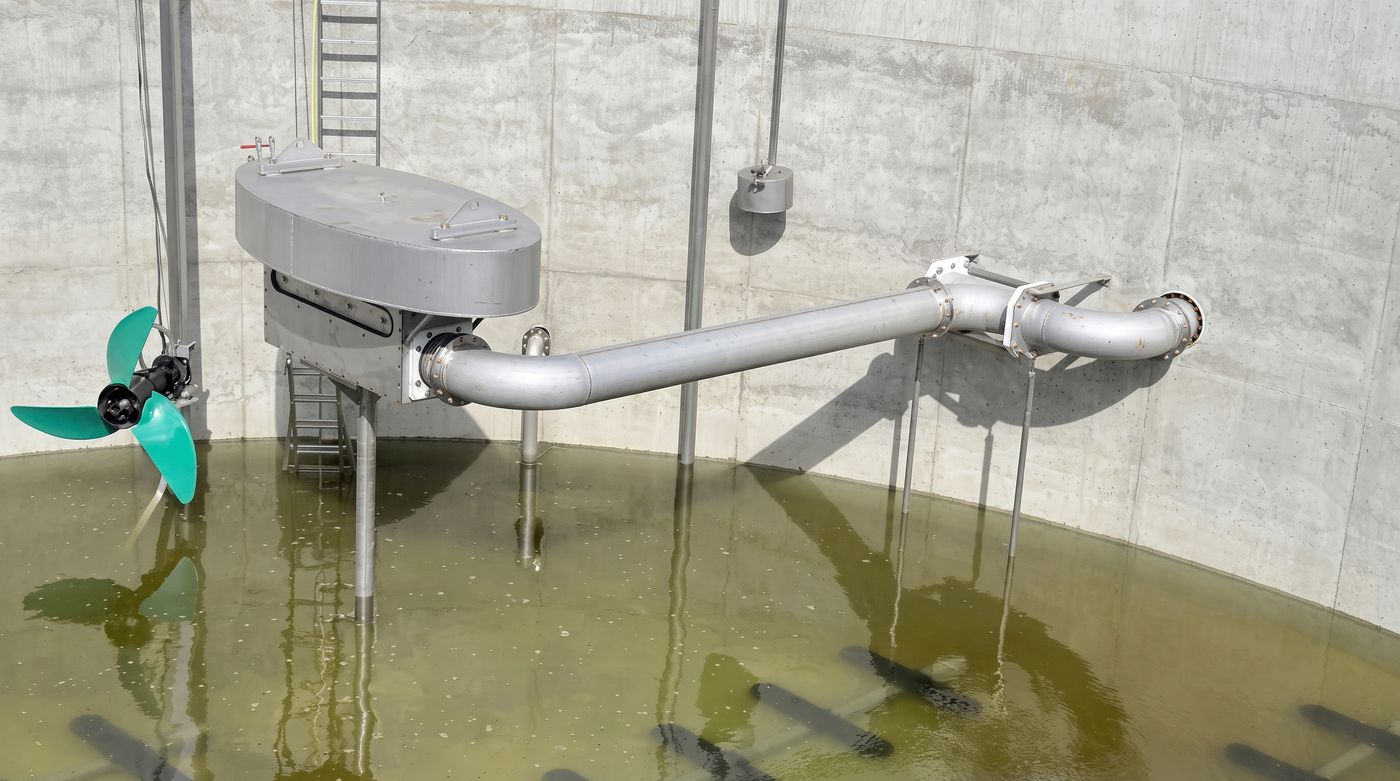
90 to 800 m³/h, all stainless steel
Clear water out.No drive in the tank.Rotaria KWA: floating decanter for SBR plants
The Rotaria KWA decants clear supernatant from below the water surface of your SBR tank, with no drive in or on the tank. All stainless steel, designed to the German DWA‑M 210 guideline, with two self-acting flaps that stay sealed while the tank is aerated and mixed.
- 90 to 800m³/h decant rate
- 0drives in the tank
- 316Tiall stainless steel (1.4571)
- DWA‑M 210design basis
- -20 °Cfrost-proof
How the SBR decanter works
Fill and aerate
The float rises with the water level. The flaps of the decanting chamber are closed, so no activated sludge gets in.
Settle
The sludge settles and a clear water zone forms above it. The KWA stays closed.
Decant
The valve in the outlet chamber opens or the decant pump starts. The pressure difference opens both flaps and clear water flows from below the surface through the inlet slot into the chamber and out through the outlet pipe.
Follow the level
The float keeps the chamber at a constant depth below the surface and goes down with the water level. When the valve closes, the flaps drop shut under their own weight.
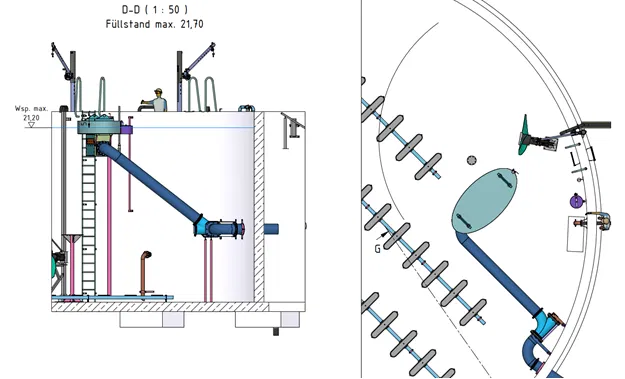
Technical data
| Type | floating decanter with decanting chamber and two weighted closing flaps |
|---|---|
| Drive in/on the tank | none |
| Control | motorised valve in the outlet chamber or decant pump |
| Design basis | German DWA-M 210 guideline for SBR plants |
| Frost protection | down to -20 °C (support structure below the bottom water level) |
| Outlet pipe | rigid stainless steel pipe with swivel bearings at the tank wall |
| Fault protection | floor stand limits the lowest position |
| Commissioning | filled and vented via ball valves while the tank is filled |
| Float, decanting chamber, outlet pipe, supports | stainless steel 1.4571 / AISI 316Ti (alternatively 1.4404 / 316L) |
| Seals | EPDM |
| Float | welded stainless steel |
| Decant rate | 90, 100, 105, 387 m³/h (25 to 108 l/s) |
|---|---|
| Outlet | DN 100 to DN 300 |
| Tank depth | 5 to 6 m |
| Water level variation | approx. 1.5 to 1.9 m |
Options
- Holder for an MLSS/TSS probe on the float, removable from the tank edge, adjustable immersion depth
- Pressure sensor with protective tube
- Guide rails
- Flexible hose connection
Sizes
We build the Rotaria KWA for decant rates from 90 to 800 m³/h and size it precisely to your tank.
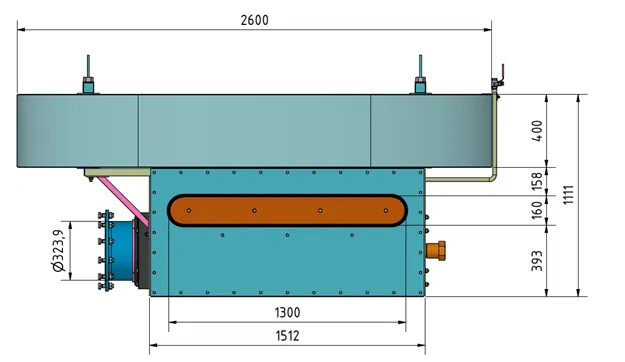
Dimensions, example 387 m³/h
| Float (L × H) | 2,600 × 400 mm |
|---|---|
| Decanting chamber, length | 1,512 mm |
| Inlet slot (L × H) | 1,300 × 160 mm |
| Top of inlet slot | 158 mm below underside of float |
| Overall height of decanter head | 1,111 mm |
| Outlet | Ø 323.9 mm (DN 300) |
Where the KWA fits and where it does not
Suitable for
- Municipal and industrial SBR plants
- Retrofitting existing SBR tanks
- Tanks from about 4 m deep
- Water level variation up to approx. 1.9 m
- Decant rates from 90 to 800 m³/h
- Outdoor installation down to -20 °C
Not suitable or to be checked
- Tanks without a motorised valve or decant pump for control
- Water level variation above approx. 1.9 m
- Very shallow tanks under about 4 m
- Decant rates above 800 m³/h
- Tanks with a very thick scum layer
References
Over 100 Rotaria KWA decanters built.
In municipal and industrial SBR plants, from 90 to 800 m³/h. Reference list on request.
Tender specification
Copy the text straight into your bill of quantities or specification. Fill in the dotted fields for your project. We are happy to help with the sizing.
Short description: Floating decanter for SBR tanks, stainless steel, no drive
Supply and install, ready for operation, a floating decanter for an SBR tank, designed in accordance with the German DWA-M 210 guideline.

All parts in stainless steel 1.4571 (AISI 316Ti), alternatively 1.4404 (AISI 316L). Seals in EPDM.

Welded stainless steel float keeping the decanting chamber at a constant depth below the water surface. Decanting chamber with inlet slot and two weighted closing flaps: the flaps open passively by pressure difference during decanting and close under their own weight. Sealed during aeration and mixing, no activated sludge enters the decanting chamber.

No drive in or on the tank. Decanting controlled by others via a motorised valve in the outlet chamber or via the decant pump.

Rigid stainless steel outlet pipe with swivel bearings at the tank wall. Floor stand limiting the lowest position in the event of a fault. Support structure below the bottom water level, frost-proof down to -20 °C. Filling and venting device with ball valves.

Hydraulic data:
Decant rate: ...... m³/h
Outlet pipe: DN ......
Water level variation (top to bottom water level): ...... m
Tank depth: ...... m

Options (to be specified as provisional items if required):
- Holder for MLSS/TSS probe on the float, removable from the tank edge, adjustable immersion depth
- Pressure sensor with protective tube
- Guide rails
- Flexible hose connection

Make: Rotaria KWA or approved equal
Make offered: ......
Type: ......
Download as text (.txt)Download as PDFRequest GAEB or Word file
Downloads
SBR decanter FAQ
How does an SBR plant work, and what does the decanter do?
An SBR treats wastewater in one tank, step by step, instead of in several tanks side by side. Each cycle runs through fill, aeration and mixing, settling and decanting. After settling, the clear treated water sits on top and the activated sludge at the bottom. The decanter then draws off the clear water just below the surface without taking sludge or floating matter with it. The Rotaria KWA is built for SBR plants from 90 m³/h decant rate, not for small package plants serving single houses.
How does a floating decanter work?
A stainless steel float carries the decanting chamber and keeps it at a constant depth below the water surface. When the valve in the outlet chamber opens or the decant pump starts, the pressure difference opens both closing flaps. Clear water flows from below the surface into the chamber and out through the outlet pipe, while the float goes down with the water level.
Does the decanter need a motor or power in the tank?
No. There is no motor, no actuator and no electrical equipment in or on the tank. Decanting is controlled by a motorised valve in the outlet chamber or by the decant pump.
How does the KWA keep activated sludge out of the effluent?
During aeration and mixing the two weighted closing flaps are shut and sealed, so no activated sludge collects in the decanting chamber. The flaps only open when the pressure difference builds up during decanting and close again under their own weight.
What decant rates are available?
We have supplied decanters for 90, 100, 105 and 387 m³/h with outlets from DN 100 to DN 300. Overall we build from 90 to 800 m³/h. We size the right unit for your plant.
Which design standard does the decanter follow?
The German DWA-M 210 guideline for activated sludge plants with sequencing batch operation (SBR).
What material is the decanter made of?
All stainless steel 1.4571 (AISI 316Ti), or 1.4404 (AISI 316L) on request. Seals are EPDM.
Is the decanter frost-proof?
Yes, down to -20 °C. The support structure sits below the bottom water level.
What happens if the tank drains in a fault?
A floor stand limits the lowest position. The float rests on it, and the decanting chamber and outlet pipe are protected from damage.
How is the decanter commissioned?
The system is always full of water. During commissioning it is filled and vented via ball valves while the tank is being filled.
Can the KWA be retrofitted into an existing SBR tank?
Yes. Rotaria also retrofits the KWA into existing SBR tanks.
Is there a ready-made tender specification?
Yes. Copy the full text from this page or download it as a file. Make: “Rotaria KWA or approved equal”.
Images have been optimised for better presentation.
Sizing for your SBR plant
Send us your tank dimensions, water levels and decant volume. We size the KWA and send you the tender specification and dimension drawing for your project.
Worldwide delivery. Advice in German and English.